Practice growth guide
How to Scale a Group Therapy Practice in Ontario
Clinic growth for therapy owners is not simply hiring more clinicians. A practical framework for therapists and Canadian clinic owners building a group practice: readiness, systems, hiring and compensation in CAD, PHIPA basics, acquisition, intake conversion, and how the owner role must change—without hype.
Updated September 6, 2026 · Originally published February 20, 2026
- Systems-first growth, not headcount for its own sake
- Marketing, intake, and operations treated as one pipeline
- Ontario hiring, compensation, and privacy context
- Ontario-based, virtual consulting across Canada

Quick answer
Scaling a group therapy practice is not simply hiring more clinicians. Sustainable clinic growth requires a repeatable way to attract qualified leads, convert them through intake and consults, retain clients, and run scheduling and admin without the owner in every thread. When those pieces are weak, adding therapists usually adds chaos—not profit.
On this page you will see what “scaling” actually means, a readiness scorecard, a staged roadmap, the systems that should exist before aggressive hiring, how employee vs contractor decisions work in Ontario/Canada, CAD compensation math, year-one ramp expectations, PHIPA and records basics, extended-health realities, and how marketing, consult conversion, and retention work together.
What you will learn
- How growth differs from a scalable operating model
- A scored readiness check before you hire
- Four practical stages from foundation to operational maturity
- Hiring models, first-hire playbook, and compensation math in CAD
- Why intake and retention often matter more than raw lead volume
- How the owner role must shift as the team grows
What scaling actually means
Growth can mean more revenue this quarter. Scale means you can add capacity (clinicians or sessions) without linear growth in your time, rework, and firefighting. Many practices grow revenue while the owner becomes more exhausted—that is growth without scale.
Common mistakes we see when practices try to “scale” too early:
- Hiring clinicians before intake, scheduling, and billing workflows are documented
- Relying on the owner's network as the only predictable lead source
- Weak or slow response to website inquiries and voicemail
- Generic positioning (“we see everyone”) that makes marketing and SEO expensive
- Adding modalities or populations before the core offer is full and referrable
- Copying US insurance-credentialing playbooks that do not match Canadian private-pay and benefits realities

Readiness scorecard: when you are ready to scale—and when you are not
Score yourself honestly. Give one point for each item that is clearly true today. Use the totals as a gate—not as motivation to rush.
- Turning away 5+ suitable inquiries per month for 3+ consecutive months, or running a consistent waitlist
- You can name your primary niches and who you do not serve
- You know which channels produce your best clients (referral, search, ads, directory)
- Inquiries get a first reply within one business day (ideally same day)
- There is a documented consult or intake path someone else could follow
- Scheduling, cancellations, and notes are not trapped only in your head
- Personal/practice cash flow can absorb 3–6 months of associate ramp and extra overhead
- You know session fee, average utilization, and rough contribution margin per hour
- You have an accountant (or bookkeeper + CPA) who understands multi-clinician setups
- You want to manage people—not only do clinical work
- You are willing to reduce some clinical hours to lead hiring, ops, and quality
- You can give feedback, set expectations, and hold a weekly ops rhythm
Move into Stage 2 hiring with a written offer, onboarding checklist, and a 90-day utilization plan. Keep marketing and intake tight while the first associate ramps.
Strengthen demand tracking, response speed, consult structure, and cash buffer first. Hiring to “fix” weak positioning or chaotic intake usually multiplies stress. Not ready to hire yet? Start with the stage map in how to grow a private practice, or see getting private therapy clients in Ontario if demand is the weak link.
A staged roadmap to grow a group therapy practice
Use this as a sequence, not a checklist to rush. Each stage has one primary KPI so you know whether you are ready to move on.
Clarity and capacity to serve demand well.
- What to build:
- Ideal client, service menu, fees, policies, basic website, one primary booking path.
- Biggest mistake:
- Optimizing ads before the website and intake can convert.
- KPI that matters:
- Consult-to-booking rate; time-to-first-response on inquiries.
Replicate your standard of care without you in every session slot.
- What to build:
- Role descriptions, hiring model (employee vs contractor), onboarding checklist, note and handoff norms, shared calendar rules.
- Biggest mistake:
- Hiring part-time without enough demand to protect their hours.
- KPI that matters:
- Clinician utilization (sessions booked / available hours).
Steady flow of qualified leads and a tight path to first session.
- What to build:
- Service pages, local visibility, optional paid search, scripted consult flow, admin coverage.
- Biggest mistake:
- Buying leads when intake leaks (slow reply, no follow-up).
- KPI that matters:
- Cost per booked client (blended); lead-to-consult speed.
Decisions and exceptions flow through systems and leads, not only you.
- What to build:
- Weekly ops rhythm, simple dashboards, clear escalation rules, middle management or lead clinician, retention systems.
- Biggest mistake:
- Adding locations or services while the core engine is still brittle.
- KPI that matters:
- Owner hours on admin; revenue per full-time equivalent clinician; retention / rebooking rate.

The systems you need before hiring aggressively
Hiring into a broken pipeline burns cash and morale. These systems are the minimum viable operating layer for most group practices we work with.
Intake workflow
Single inbox, assignment rules, SLAs for first reply, and clear handoff to scheduling.
Lead response speed
Target response within business hours; after-hours auto-reply with next steps.
Consult call process
Structured questions, fit criteria, fee conversation, and same-day booking offer when appropriate.
Scheduling and admin
One source of truth for calendars; cancellation and no-show policy applied consistently.
Clinician onboarding
First-week checklist: caseload expectations, documentation, supervision touchpoints.
Documentation and SOPs
Short Looms or written SOPs beat perfect policy manuals nobody reads.
Payroll and contractors
Clear employment or contractor model, splits, invoicing rhythm, and who owns receivables risk.
Reporting
Weekly snapshot: inquiries, consults held, new clients, utilization, and no-shows.
Need help building intake and booking flows? See our intake system build and done-with-you consulting.
Ontario hiring model: employee vs independent contractor
In Canada, group practice owners typically choose between employees and independent contractors. The label on the agreement does not decide the relationship—control, financial dependency, and integration into your business do. Misclassification can create payroll tax, ESA, and liability exposure.
- You set schedule expectations, tools, and service standards
- Payroll source deductions, EI/CPP where applicable, vacation rules under ESA
- Stronger quality control and brand consistency
- Typical clinical splits often land roughly in the mid-40s to mid-50s % of collected fees (highly variable)
- More autonomy over how/when work is done; they invoice the practice
- Usually a higher % of collections; practice retains less for overhead
- Requires crystal-clear contracts on records, IP, non-solicit, and privacy
- Higher risk if you still control schedule, fees, and methods like an employer
This is a decision framework, not legal or tax advice. Before you hire, speak with an employment lawyer familiar with Ontario health practices and a CPA who understands CRA contractor vs employee factors.
Deeper walkthrough: group practice compensation models in Canada.
How to hire your first (and next) associate therapist in Ontario
Your first hire should reduce chaos—not create it. Most successful solo-to-group transitions hire either a “continuity” clinician (similar niche and style to the owner) or a complementary niche you already refer out frequently.
Who to hire first
- Continuity hire: similar modality and population so you can transfer overflow and free CEO time.
- Complementary hire: couples, adolescents, trauma, assessments—whatever you consistently turn away—so demand stays inside the practice.
- Prefer fully registered clinicians when your goal is reducing supervision load; pre-licensed roles only make sense if you want that training pathway.
Where Ontario owners recruit
- Indeed with exact titles clients and clinicians search: “Registered Psychotherapist,” “Registered Social Worker,” “Clinical Psychologist,” etc.
- Professional association job boards and member email lists
- Warm referrals from supervisors, training programs, and peer networks
- LinkedIn for niche or assessment-heavy roles
When to post the next role
Do not wait until every clinician is 100% full. A practical rule: start recruiting when your newest clinician is roughly 60–70% utilized, so interviews and onboarding overlap with rising demand instead of a painful waitlist spike.
Step-by-step hiring guide: how to hire your first associate therapist in Ontario. Structured support: solo → group practice program.
Group practice compensation and the math behind seven figures
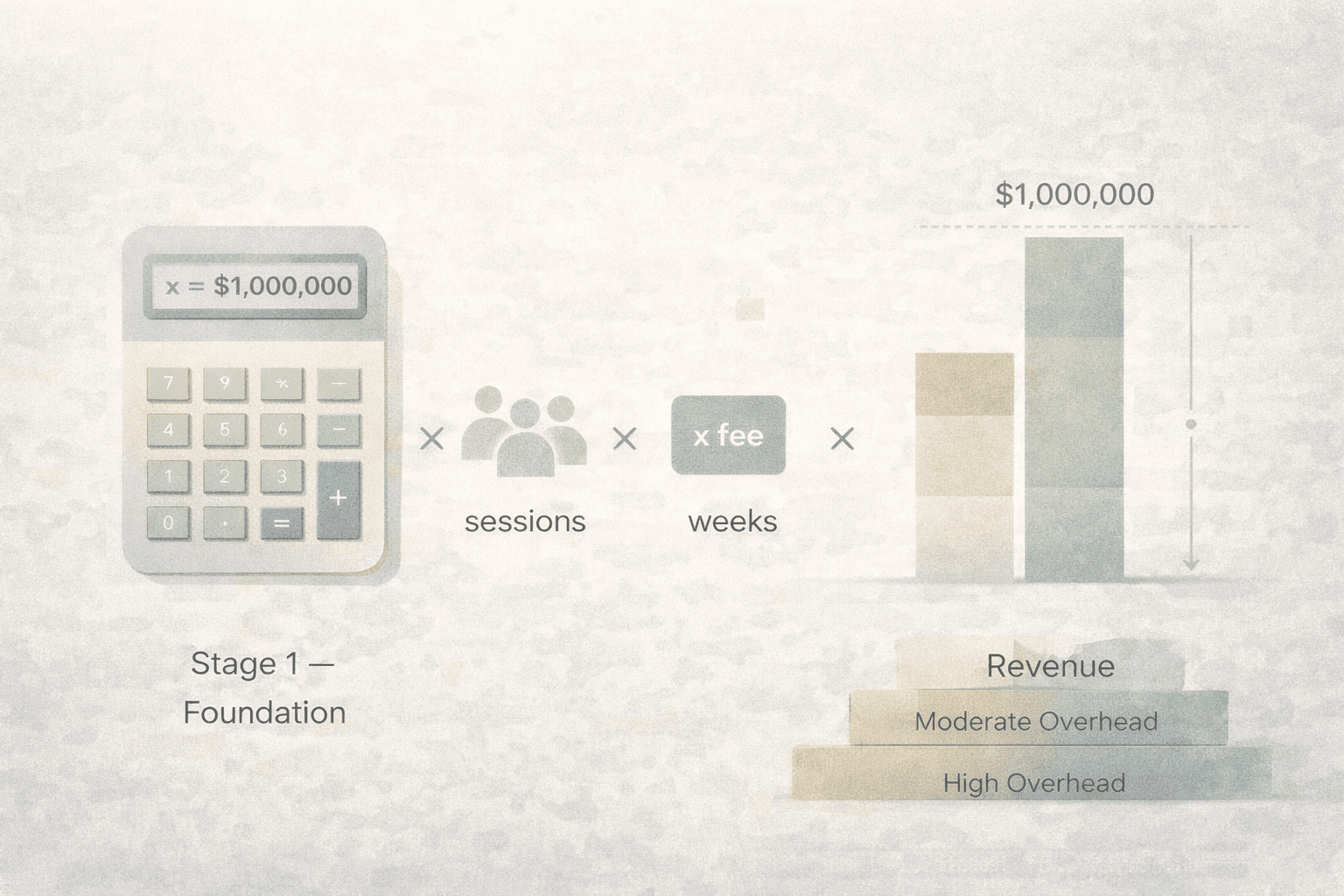
Seven figures in gross revenue is arithmetic, not magic. More important for owners: whether each clinician contributes margin after split, rent, software, marketing, admin, and your leadership time.
Illustrative associate economics (CAD)
Example only — not a promise of results. Adjust to your fees and market.
- Fee: $180 / session
- Average billable: 20 sessions / week × 46 weeks = 920 sessions / year
- Gross clinical revenue ≈ $165,600
- Clinician split at 50% of collected ≈ $82,800
- Practice share before overhead ≈ $82,800
From the practice share, subtract allocated rent/virtual overhead, software, marketing attributable to filling that caseload, admin time, payment processing, and benefits if employed. What remains is contribution toward owner compensation and profit. If the split is too high relative to overhead, you buy a job managing people with thin (or negative) margin.
Run your own fee, caseload, split, employee burden, overhead, and acquisition assumptions in the free Associate Therapist Compensation Calculator.
Practice-level seven-figure sketch
Assume 4–6 full-time equivalent clinicians, each averaging 22–26 billable hours per week, at roughly $150–$190 per session (CAD), 46 working weeks.
Rough order of magnitude: that band often lands in the high six figures to low seven figures in gross clinical revenue before overhead.
Common mistake: overpaying the first hire out of generosity, then discovering sick days, software seats, marketing, and supervision ate the margin. It is easier to raise compensation later than to reverse an unsustainable split.
Year-one ramp: realistic expectations for your first associate
The first three months are usually an investment period. Practices that expect instant full utilization set themselves—and the clinician—up for frustration.
| Metric | Months 1–3 | Months 4–6 | Months 7–12 |
|---|---|---|---|
| Associate caseload | 5–12 clients / week | 12–20 clients / week | 18–25+ clients / week |
| Owner clinical hours freed | 0–3 hours | 3–6 hours | 5–10+ hours |
| Net revenue impact | Break-even or slight loss | Positive contribution | Meaningful profit if util is healthy |
| Owner focus | Onboarding, pipeline, weekly check-ins | Fill calendars, tighten intake | Systems, next hire, leadership |
Ranges vary by city, niche, fee, hybrid/virtual mix, and marketing strength. Treat them as planning anchors, not guarantees.
Compliance and records for Ontario group practices (without US credentialing noise)
US articles obsess over NPI, CAQH, and payer panels. Most Ontario psychotherapy and counselling group practices scale primarily on private pay and extended health benefits—not provincial physician-style insurance panels. Your operational risk looks different: privacy, college standards, contracts, and clear ownership of the clinical record.
PHIPA & vendor access
Know who is the health information custodian for your setting, how associates access charts, and that EHR/email vendors have appropriate agreements.
Record ownership
Spell out in agreements who owns the client file when a clinician leaves, how transfers work, and what clients are told.
College & title awareness
Hire to the right protected titles (e.g. RP, RSW, psychologist) and keep supervision / quality structures aligned with your college expectations.
Associate agreements
Cover compensation, confidentiality, non-solicit where enforceable, notice periods, and dispute paths—drafted or reviewed by counsel.
Not legal advice. Confirm obligations with a lawyer familiar with PHIPA and your profession's college (e.g. CRPO, OCSWSSW, CPO) before you onboard clinicians.
Extended health and direct billing when you scale
In Canada, many clients pay privately and submit receipts to employers' extended health plans. Some practices offer direct billing to insurers; others stay receipt-only. As you add clinicians, benefits admin becomes a real capacity cost—not a side task.
- Confirm which professions and titles each major insurer accepts for your services before promising coverage language on the website.
- Decide early: receipts only vs direct billing, and who owns that workflow (clinician, admin, or owner).
- Train every new hire on receipt requirements, session notes timing, and how clients ask about benefits—inconsistent answers erode trust.
- Do not import US “credential every payer before they start” timelines wholesale; map your actual Canadian admin path instead.
How to actually fill clinician calendars
1. Positioning and niche clarity
Specific service pages (“anxiety therapy for professionals,” “couples in crisis”) outperform generic homepages for search and ads. Align with what you can staff and deliver consistently.
2. Website conversion
One primary action per page, mobile-fast load times, fees or ranges where appropriate, and trust signals (approach, credentials, process). See website optimization.
3. Local SEO and search visibility
Google Business Profile, consistent NAP, and content that answers how clients search in your city. Our local growth retainer supports this when you are ready to invest consistently. Also see local SEO for private practices in Ontario.
4. Paid ads, referrals, follow-up
Google Ads can work when intake is tight; referrers need simple pathways and occasional touchpoints. Always instrument follow-up on non-booked consults where ethics allow. Related: Google Ads for psychotherapy clinics and getting referrals as a therapist.
Consult conversion script: why intake matters as much as marketing
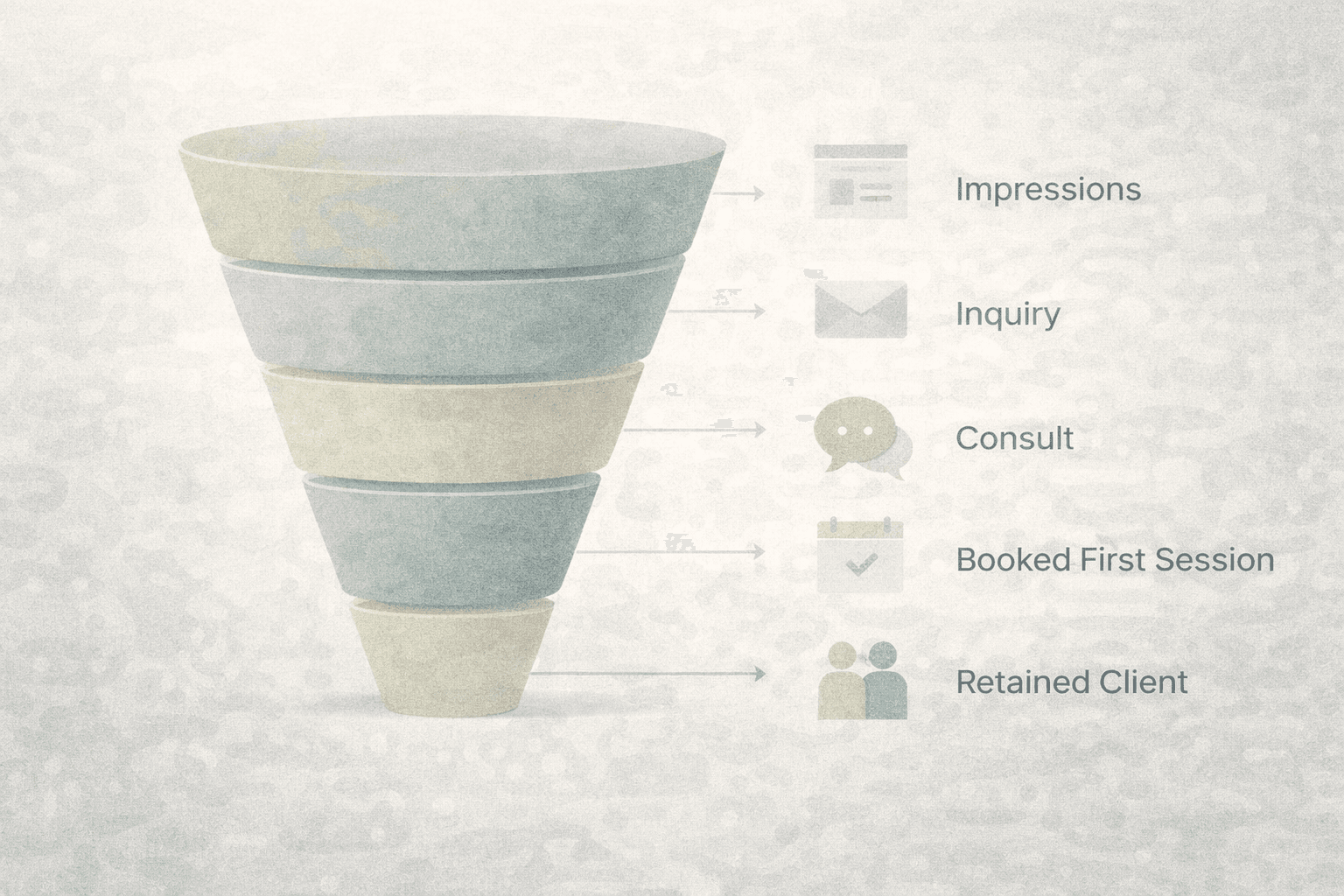
Lead generation without conversion is expensive noise. Practices leak revenue in slow replies, vague consults, calendar friction, and unclear next steps after the call. A simple 15–20 minute consult structure often raises yield without increasing ad spend.
Response SLAs worth protecting
- First human reply within one business hour when possible; same day at minimum
- After-hours auto-reply that sets expectations and offers a booking path
- One owner of the inbox—not “whoever notices”
Steal-able 15–20 minute consult outline
- Open (1–2 min): thank them, confirm time available, set agenda.
- Understand (5–7 min): presenting concerns, goals, urgency, prior therapy, logistics (virtual/in-person, evenings).
- Fit (3–4 min): how your practice works, who on the team may be the best match, what you do not treat.
- Fees & policies (2–3 min): session fee, cancellation, benefits/receipts, payment.
- Book (2–3 min): offer two concrete first-session times before ending the call; confirm next steps in writing.
More on converting inquiries: therapy intake that converts.
Retention systems that protect utilization
Filling calendars is only half of scale. High churn forces constant acquisition, burns clinician morale, and hides behind “we need more marketing.” Build retention into the operating system.
Rebooking norms
Default to booking the next session before the client leaves (or ends the video call). Make the exception the one-off, not the habit.
No-show salvage
Same-day outreach script, clear fee policy, and a waitlist of clients who want earlier slots to fill holes fast.
Caseload health checks
Weekly glance at each clinician’s utilization, upcoming openings, and clients at risk of dropping—before calendars go quiet.
Referral asks
When clinically appropriate, invite satisfied clients and professional referrers to send people who fit your niches—with a simple path.
The owner role has to change
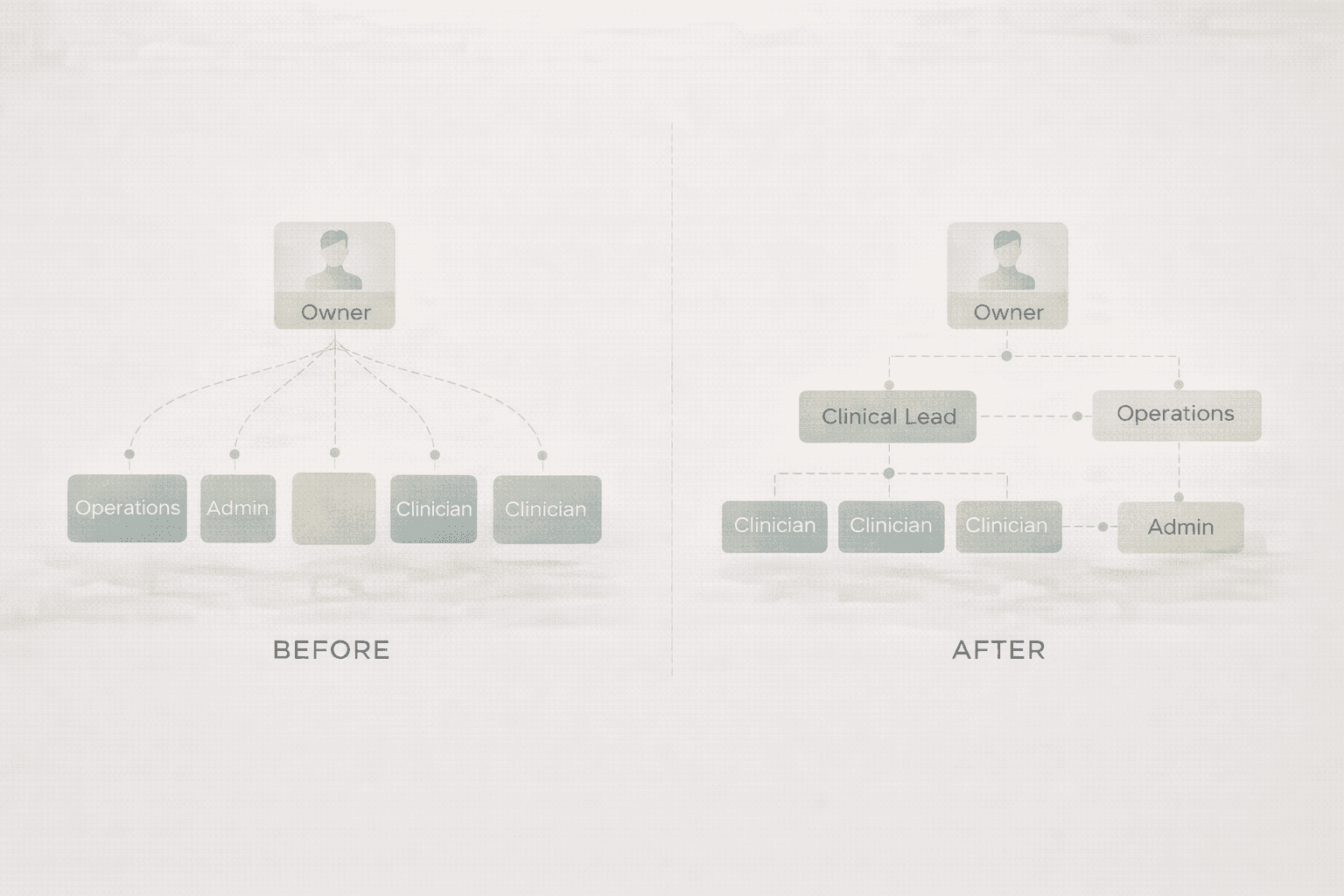
Beyond a certain size, the owner cannot be the primary clinical capacity and the only operator. Scaling requires delegation: clear scorecards (e.g. utilization, consult conversion, wait time to first session), a weekly management rhythm, and explicit decision rights so bottlenecks surface early.
Hands-off leadership is a common failure mode. Structure early—expectations, documentation standards, and feedback—so you are not introducing rules only after resentment builds.
SOP and weekly metrics checklists
Print or copy these into your ops doc. Short lists beat unread policy binders.
Minimum SOP set before hire #2
- How inquiries are received and who replies
- Consult / intake script and fit criteria
- Booking, cancellation, and no-show rules
- Note timing and documentation standards
- Onboarding day-1 to day-14 checklist
- Who escalates clinical or admin exceptions
- How payroll / invoices are processed
- Privacy / PHIPA basics for the team
Weekly dashboard (keep it small)
- New inquiries
- Consults held
- Consult → booked rate
- New clients started
- Clinician utilization %
- Avg wait to first session
- No-show / late cancel rate
- Revenue per clinician (optional monthly)
Common bottlenecks that keep practices stuck
How Allied Edge helps
We work with therapists and allied health clinic owners who want practical systems—not generic motivation. Typical engagements focus on client acquisition, intake and consult conversion, operational clarity, and the transition from solo provider to team-based growth.
- Entrepreneur therapist for the owner-operator role (numbers, cadence, hiring timing)
- Therapy practice consulting for strategy, prioritization, and accountability
- Done-for-you services when you want implementation support
- Solo → group practice program when you are hiring your first clinicians
- Private therapy clients in Ontario — companion resource on acquisition fundamentals
- Scaling psychotherapy practices — shorter overview of solo-to-group systems
This is for you if…
- You are moving from solo to a small group and want a sane sequence
- You have clinicians but lack a predictable growth and intake system
- You get leads but lose them between inquiry and first session
- You need operating structure before opening another location or service line
- You want sustainable growth without sacrificing clinical quality or ethics
Frequently asked questions
- How do I scale a group practice without breaking operations?
- Scale a group practice by making demand, intake, utilization, and owner systems repeatable before you add headcount. Hiring more therapists into a leaky pipeline is headcount, not scale.
- What are group practice growth strategies that actually work in Canada?
- Local search and referrals for qualified demand, intake that books consults the same day, associate compensation that survives overhead, and an owner role that is not in every thread. US insurance-panel playbooks are usually the wrong map for Ontario private-pay and benefits practices.
- How do I scale a group therapy practice sustainably?
- Each hire is funded by predictable inquiries and utilization, not by the owner's leftover hours. Build the pipeline and intake SLA first, then hire, then change the owner job.
- What is clinic growth for a therapy practice?
- Clinic growth means a repeatable way to attract qualified leads, convert them through intake, retain clients, and run operations without the owner in every thread. Hiring more therapists without those pieces is headcount, not growth.
- How many therapists do I need to reach seven figures?
- There is no single number. Gross revenue depends on fees, utilization, weeks worked, and mix of services. Many practices approach seven figures in clinical gross with roughly four to six full-time equivalent clinicians at common Canadian fee bands—but overhead and owner pay determine whether that is actually a strong business.
- Should I hire before I have a waitlist?
- You need predictable demand or a clear plan to generate it. A waitlist is one signal; consistent inbound inquiries and consults are another. Hiring without a pipeline often leads to underutilized clinicians and cash-flow stress.
- What systems should a group practice have before scaling?
- At minimum: intake and response standards, a documented consult flow, scheduling rules, onboarding for new clinicians, and a weekly metrics snapshot. Add formal admin roles when owner time on logistics crowds out leadership.
- Should associates be employees or independent contractors in Ontario?
- It depends on how much control you need over schedule, methods, and branding. Employees usually fit tightly run clinics; contractors require genuine autonomy and careful agreements. Classification is based on facts, not labels—get employment counsel and a CPA before you hire.
- What compensation split is typical for group practice clinicians in Canada?
- Ranges vary widely by model, city, and benefits. Many employee arrangements land roughly in the mid-40s to mid-50s percent of collected fees; contractors often receive a higher percentage because the practice retains less for overhead. Run your overhead math before you offer a number.
- Is SEO or Google Ads better for therapy practices?
- Neither is universally better. SEO and content compound over time; ads can fill capacity faster when landing pages and intake are strong. Many mature practices use both with clear tracking.
- How long does it take to scale a group practice?
- Foundations often take a few months; predictable acquisition and full team utilization commonly unfold over one to three years depending on market, positioning, and execution—not promises, just typical ranges we observe.
- Can a therapy practice scale without multiple locations?
- Yes. Virtual care, extended hours, and a larger clinical team can grow capacity within a single physical footprint. Second locations add complexity; they rarely fix a weak core operating model.
- What is the biggest bottleneck in group practice growth?
- Frequently intake: slow response, unclear consults, and booking friction. Marketing bottlenecks matter too, but we see more practices underinvest in conversion than in attention.
- What metrics should I track in a therapy group practice?
- Inquiries, consults held, new clients, clinician utilization, average wait time to first session, no-show rate, and revenue per clinician. Keep the dashboard small enough to review weekly.
- What should a consult call process include?
- Clarify presenting concerns and goals, explain fit and approach, discuss fees and policies, answer questions, and, when appropriate, offer specific appointment times before ending the call.
- When should I hire admin support vs another clinician?
- Hire admin when delayed follow-ups are costing bookings or clinicians spend meaningful weekly time on scheduling that could be delegated. Hire another clinician when utilization is healthy and demand consistently exceeds capacity. Earlier admin is often cheaper than lost clients; earlier clinicians without demand create cash-flow stress.
- Do I need US-style insurance credentialing to scale in Ontario?
- Usually no. Most Ontario counselling and psychotherapy group practices grow on private pay and extended health benefits, with PHIPA, college standards, and clear associate agreements as the core compliance work—not NPI/CAQH payer panels.
- Who owns the client record when an associate leaves?
- That should be defined in your agreements and aligned with PHIPA and college expectations. Clarify custodianship, transfer procedures, and client communication before the first hire starts—not after a resignation.
Build a stronger group practice—not just a bigger one
If you want an outside perspective on systems, intake, and growth sequencing, start with a conversation. No pressure, no jargon—just clarity on next steps.
Jump to section
Related guides in this series
Continue through hiring & scaling.
Free playbook
Get the Intake Conversion Playbook
Ten copy-paste scripts, a response standard your team can hold in session, and a seven-day install — so more inquiries become booked first sessions.
Not ready to talk yet?
Get a free 5-minute website review
Send your clinic website and get a short video showing the messaging, structure, and intake friction that may be costing you inquiries.
Request your website review